
Marketplaces, live streaming, AI search, and your own website all sell differently in Malaysia — the channel you pick changes your real profit per order.
Bringing a brand into a new market like Malaysia means figuring out where your customers actually are — marketplaces, live streams, search, or your own website — and how to sell across all of them without losing money to fees.
This article breaks down four channels that work for entering the Malaysian market: marketplaces, live streaming, AI-powered search visibility, and your own website. We're using the premium wellness and supplement industry as the example throughout, since it comes with real regulatory and trust requirements that most other categories don't face, which makes it a useful stress test for any brand entering Malaysia. If you're still deciding whether Malaysia is the right first market at all, our Malaysia vs. Singapore market-entry playbook covers that macro decision — this article assumes you've chosen Malaysia and are now deciding how to sell there.
Malaysia's supplement market has grown from about USD 600 million in 2022 to a projected USD 1 billion by 2030 (roughly RM2.6 billion to RM4.3 billion). But the same four-channel approach applies to almost any product category entering Malaysia, especially for international and US brands that don't yet have local distribution.
The wellness and supplement industry is a useful case study because it has all the ingredients that make market entry tricky: a considered purchase, an established set of local and international competitors, a customer who researches before buying, and real regulatory requirements that most product categories don't have to deal with. If a strategy works here, including the compliance parts, it generally works for skincare, fitness gear, home appliances, or any other premium category entering Malaysia. One data point worth knowing: research on Malay women shoppers found that about 22% of them already buy herbal health products online, mainly because it's more convenient and accessible than going to a store — and that number is likely to keep growing.
A few terms used in this article:
- Marketplace: places like Shopee, Lazada, or TikTok Shop where many brands sell side by side.
- Live streaming (live commerce): selling products through a live video, where a host demonstrates the product and viewers can buy on the spot.
- AI SEO: making sure your brand shows up when people search on Google, or ask AI tools like ChatGPT or Google's AI Overviews about your product.
- LTV (Lifetime Value): how much a customer is worth to you over time, not just their first order.
- YMYL (Your Money or Your Life): Google's own classification for content that could affect someone's health, finances, or safety. Health and supplement content almost always falls into this category.
- KKLIU: the approval code issued by Malaysia's Ministry of Health for any advertisement about medicine, health supplements, or traditional products — a legal requirement, not optional.
The Four Channels That Matter
Marketplaces are usually the fastest way to get in front of new customers, because people are already browsing and searching there with intent to buy — but each of the four channels below trades speed, fees, and control differently.
1Marketplaces (Shopee, Lazada, TikTok Shop)
The tradeoff is that you're paying a commission on every sale, and you're competing next to other brands, sometimes cheaper ones. Commission rates on these platforms typically fall between 6% and 19% of the sale, and if you use affiliates or creators to promote your product, add another 5% to 30% on top of that.
2Live Streaming
Live commerce has become one of the biggest growth areas for supplements globally. Data on TikTok Shop shows that live sessions typically convert about twice as well as regular shoppable videos — more people buy during a live demonstration than after watching a normal video ad. The catch is that live sessions usually carry a higher affiliate commission than regular listings, because hosts and creators are paid more for real-time selling.
3AI SEO (Showing Up in AI Search and Google)
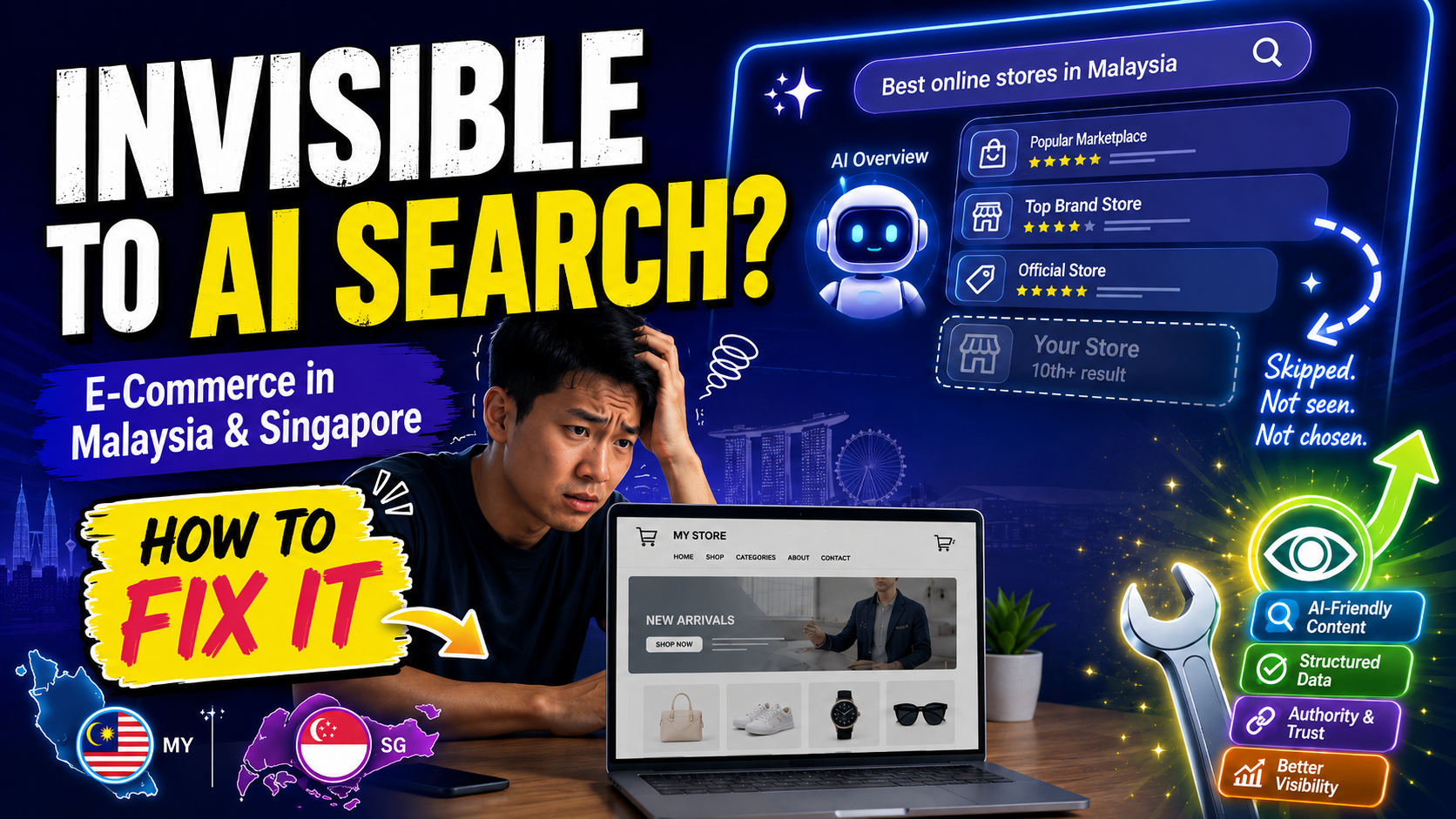
A growing number of Malaysian shoppers now use AI tools like ChatGPT or Google's AI Overviews when researching what to buy, including health products. But health and supplement content isn't treated the same way as, say, a fashion product page. Google classifies this kind of content as YMYL, short for "Your Money or Your Life" — content that could affect someone's health, financial stability, or safety — and it's held to a much higher bar for accuracy, expertise, and trustworthiness, both by Google's search algorithm and, increasingly, by AI systems that are built to avoid repeating unverified health claims. A brand with vague, exaggerated, or unverifiable claims on its product pages is less likely to be the answer an AI tool gives, and more likely to be quietly skipped in favour of a source that looks more credible — the same underlying problem we cover in why e-commerce sites go invisible to AI search.
4Your Own E-Commerce Website
This is the channel premium brands often underuse, but it matters the most for the long run. On your own website, you keep full control of your brand story, you collect your own customer data (which you don't get from a marketplace sale), and you can set up things like subscriptions for repeat supplement orders. Since supplements are naturally a repeat-purchase category, a strong website — built the way we outline in how overseas brands localise DTC growth in Malaysia — is what turns a one-time buyer into a customer worth much more over time.
Two Malaysia-Specific Requirements You Can't Skip
Beyond picking channels, two compliance requirements apply specifically to health and wellness brands entering Malaysia — and both need to be planned for before launch, not after.
1KKLIU: Getting Your Ads Legally Approved
Any advertisement for a health supplement, traditional medicine, or over-the-counter product in Malaysia needs approval from the Medicine Advertisements Board under the Ministry of Health, before it's published anywhere, including on your own website and social media. This approval is called KKLIU (Kelulusan Kementerian Kesihatan Malaysia Untuk Iklan Ubat). Once approved, the ad is given a serial number that must be displayed on the advertisement itself, and the approval is generally valid for a set period before it needs renewal.
This isn't a formality. Advertising an unregistered or unapproved health product in Malaysia is an offence under the Medicines (Advertisement and Sale) Act 1956, and consumers can and do check for the KKLIU number before trusting a health claim. For an international brand entering Malaysia, this means the ad copy, claims, and even the images used for a supplement campaign need to go through this approval process before launch, not after.
2Halal Certification: A Real Factor for Market Access
Malaysia's population is roughly 63% Muslim, and Halal certification from JAKIM (the Department of Islamic Development Malaysia) is effectively required to get shelf space in major retail chains and strong visibility on e-commerce platforms, even for a purely online supplement brand. Halal status depends on the ingredients, the manufacturing process, and documented supply chain evidence, not on a claim printed on the packaging. For health supplements specifically, a product generally needs to be registered with Malaysia's National Pharmaceutical Regulatory Agency first, before it becomes eligible to apply for JAKIM Halal certification. For international brands without an existing Malaysian entity, this usually means working with a Halal-certified local manufacturer or OEM partner, since certification attaches to the product and the facility, not to the brand's country of origin.
Build compliance into your launch timeline, not after it. KKLIU approval and Halal certification (if applicable) can each take weeks — factor both into your go-to-market date before you commit to a launch campaign.
Not sure which channel makes sense for launching in Malaysia?
We'll map the fastest path to your first sale, and the channel that builds the most long-term value for your category.
Book a ConsultationChannel Economics and Lifetime Value
It's worth being direct about this: a premium supplement brand shouldn't judge success by the first month of sales. Supplements are consumed and reordered on a recurring basis, often monthly, which means the real value of a customer isn't their first RM150 order, it's the total they'll spend across a year or more of repeat purchases. A brand that only looks at short-term return on ad spend from its first campaign is measuring the wrong thing. The better question is: once someone buys, how many times do they come back, and what does that make them worth over a year? That's exactly what LTV (Lifetime Value) is for, and it's why the "your own website" channel matters so much for this category specifically — subscriptions and repeat-order convenience compound in a way that a one-off marketplace sale never will.
Here's the part most brands don't calculate properly: the channel you sell through changes your real profit per order, sometimes by a lot. Below is a worked example using a wellness bundle priced at RM150, with a product cost of RM45 (meaning a 70% gross margin before any platform fees).
| Channel | Fees Taken From the Sale | What's Left After Fees & Product Cost | Real Profit Margin |
|---|---|---|---|
| Your own website | About 3% payment processing fee | RM150 − RM4.50 − RM45 = RM100.50 | 67% |
| Marketplace listing (no live stream) | 12% commission + 15% affiliate fee (27% total) | RM150 − RM40.50 − RM45 = RM64.50 | 43% |
| Live stream selling | 12% commission + 25% affiliate fee (37% total, higher because live commissions run higher) | RM150 − RM55.50 − RM45 = RM49.50 | 33% |
Your own website clearly keeps the most profit per sale. But live streaming and marketplaces usually sell in higher volume, because more people are actively browsing there, and live sessions convert at a higher rate than a normal listing. So the real question isn't "which channel has the best margin," it's "how much more volume does the lower-margin channel need to bring in, to be worth it?" To match your website's RM100.50 profit per order, your live stream channel — earning RM49.50 per order — needs to sell about 2 times as many units. If your live sessions are converting at 5% to 8% (which is common) compared to a website's usual 1.5% to 3%, that volume difference is often very achievable, which is exactly why live commerce has become so popular for wellness brands. But it only works if you're tracking real profit, not just total sales, and even more so once you factor in that a repeat customer on your own website is worth several times a single order.
Comparing the Four Channels
Putting speed, fees, control, and compliance side by side makes the tradeoffs clear:
| What You Want to Know | Marketplace | Live Streaming | AI SEO / Google | Own Website |
|---|---|---|---|---|
| Speed to first sale | Fast | Fast | Slow (takes months to build up) | Medium (needs traffic first) |
| Typical fees | 6% to 19% commission, plus affiliate fees | Same commission, but higher affiliate fees (often 20% to 30%) | AI SEO agency fees | Less fees — normally just payment processing (about 3%) |
| Conversion rate | 1.5% to 3% typical | 5% to 8%, sometimes higher during live sessions | 1.5% to 3% once traffic arrives | 1.5% to 3% |
| You keep customer data? | No, the platform keeps it | Usually no | Yes, if it leads to your site | Yes, fully |
| Compliance to plan for | KKLIU approval for any product claims | KKLIU approval, plus real-time claims made by hosts need to stay compliant too | YMYL standards, accurate and verifiable content | KKLIU approval, Halal certification if applicable |
| Best for | Fast reach, new customer attraction, but may attract bargain hunters | High-energy launches, demo-heavy products | High-intent searches | Subscriptions, loyalty, highest margin |
Whether you're selling supplements, skincare, fitness equipment, or something else entirely, a brand entering Malaysia doesn't need to pick just one channel. Marketplaces and live streaming bring in customers fast, but they cost more per sale in fees. Your own website keeps the most profit and lets you build a real relationship with the customer, including getting them to reorder, which matters most for repeat-purchase categories like supplements. AI SEO sits underneath all of this, but for health and wellness content specifically, it comes with a higher bar: claims need to be accurate and verifiable, not just persuasive, because this is YMYL territory for both Google and AI tools. Treat all of this as a system, not separate boxes to check: use marketplaces and live streaming to bring people in, use your website to keep them and grow their lifetime value, and build the compliance work into your launch timeline from day one rather than bolting it on afterward.
About Nextsclick Digital
Nextsclick Digital is a Malaysia-based ecommerce and performance marketing agency helping DTC, retail, wellness, and consumer brands enter and grow in the Malaysian market through marketplace strategy, live commerce, AI search visibility, structured data, paid media, and conversion optimisation across Malaysia and Singapore.
Frequently Asked Questions
Common questions from e-commerce brands about how Malaysian shoppers search for products.
Yes. Malaysia's nutritional supplements market is projected to grow from about USD 600 million in 2022 to USD 1 billion by 2030, according to U.S. Commercial Service trade data. Several established international supplement groups have reported strong recent growth specifically in the Malaysian market, alongside other regional markets.
It depends on your stage. If you're new and need visibility fast, marketplaces and live streaming bring in customers quickly, though they take a bigger cut of each sale (commissions plus affiliate fees can add up to 30% to 40% of revenue). A well-built website keeps around 97% of the sale after payment fees and is the better long-term investment for repeat customers, since supplements are a category people reorder regularly, often monthly. Most successful premium brands run both at the same time: marketplaces and live streaming for reach, and a website to build lasting customer relationships and lifetime value.
Yes. Any advertisement for a health supplement, traditional medicine, or over-the-counter product needs KKLIU approval from Malaysia's Medicine Advertisements Board before it's published, including on your own website or social media. The approved ad is given a serial number that must be displayed on it, and unapproved health advertising is an offence under Malaysian law.
It's not always a legal requirement, but it's close to a practical one. With roughly 63% of Malaysia's population being Muslim, Halal certification from JAKIM significantly affects access to major retail chains and visibility on e-commerce platforms. For health supplements, the product generally needs to be registered with Malaysia's pharmaceutical regulator first, before it's eligible to apply for Halal certification.
Nextsclick Digital designs multi-channel launch strategies — marketplace and live commerce setup, AI-search-ready content for YMYL categories, and compliance-aware campaigns — so your brand can enter Malaysia through the right channels from day one, with KKLIU and Halal requirements built into the plan instead of causing delays later.