A 4-step N-ROAS framework to defend marketing budget when marketplace take-rates erode net margin.
When platform acquisition fees spike, finance departments inevitably look to marketing budgets to plug the leak. Surviving these budget reviews requires moving past vanity ROAS metrics and presenting a clear, step-by-step operational strategy that directly protects net margin.
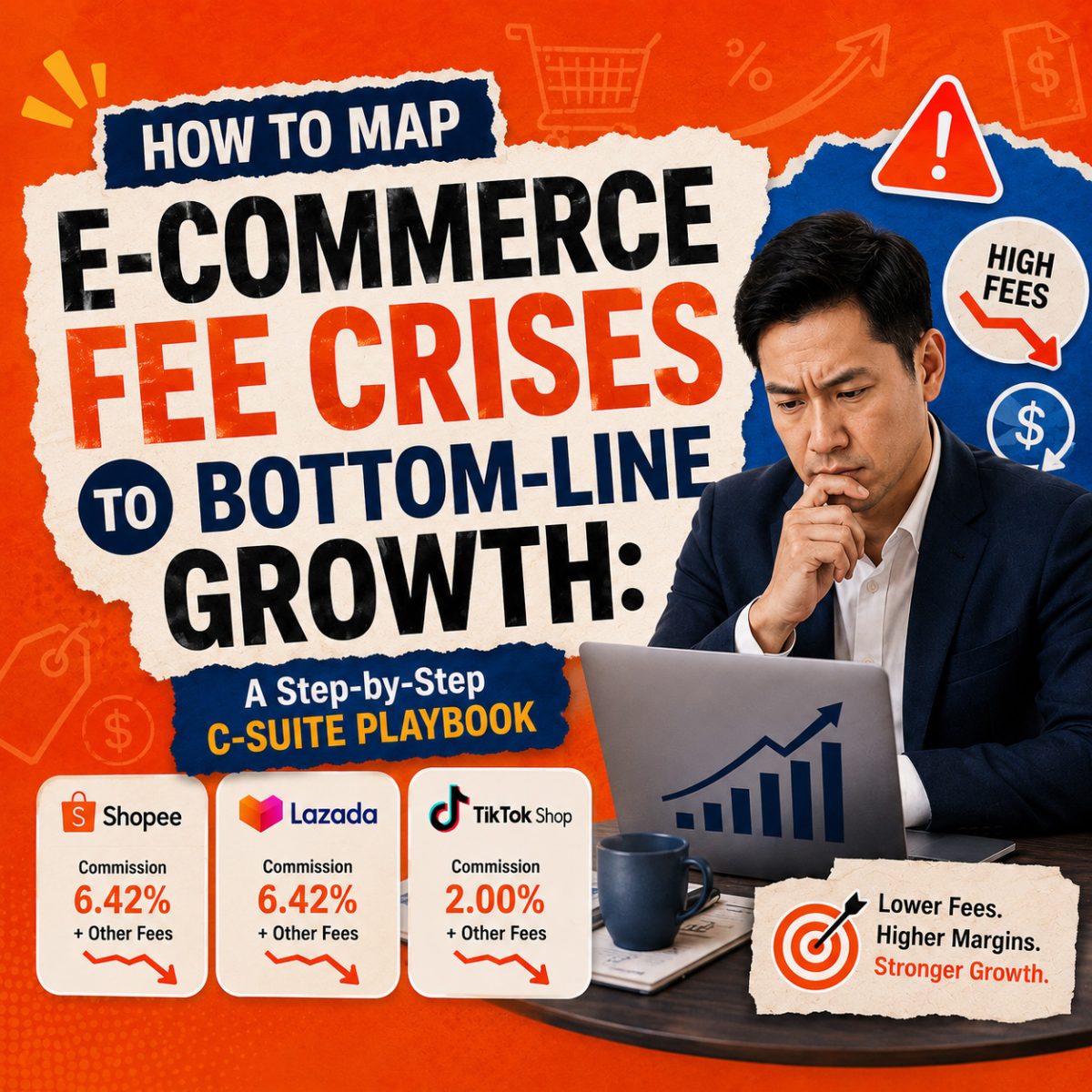
Marketplace economics across Southeast Asia shifted significantly in 2026. As explored in our breakdown of regional e-commerce channel dynamics for overseas manufacturers, the combination of Shopee's service fee updates (including campaign day surcharges) and Lazada's category commission adjustments pushed effective take-rates for non-Mall sellers to between 10% and 14%. When added to standard payment processing costs, low-margin products lose profitability instantly.
Here is the 4-step framework to align your acquisition strategy with CFO priorities and secure budget approvals.
10–14%Effective marketplace take-rate for non-Mall sellers in 2026
+18%Margin improvement from shifting single items to multi-pack bundles
4-StepN-ROAS framework to secure CFO budget sign-off
Margin Impact Breakdown: Why Fee Hikes Hit Low-Ticket Items Hardest
Percentage-based commissions combined with flat, fixed order-processing costs don't scale evenly. On a low-ticket item, those fixed costs consume a much larger share of revenue than on a bundled, higher-value cart — which is exactly why AOV, not ad creative, is the first lever to pull.
Low AOV Single Item ($15): Fixed shipping + payment fee = High margin erosion (~14% take-rate)
High AOV Multi-Pack ($60): Fixed overhead diluted across items = Net margin yield restored (+18% margin improvement)
The 4-Step Framework to Secure CFO Budget Approval
Each step below moves your reporting and acquisition strategy away from vanity metrics and toward numbers a finance department will actually defend in a budget review.
1Re-Engineer Your Average Order Value (AOV) Floor
Percentage-based commission fees combined with flat order-processing costs destroy margins on low-ticket items. Shift your promotional focus from single items to curated multi-packs and high-value bundles. Diluting fixed fulfillment overhead across a larger shopping cart directly increases net yield per transaction.
2Calculate Net-Margin-Adjusted ROAS (N-ROAS)
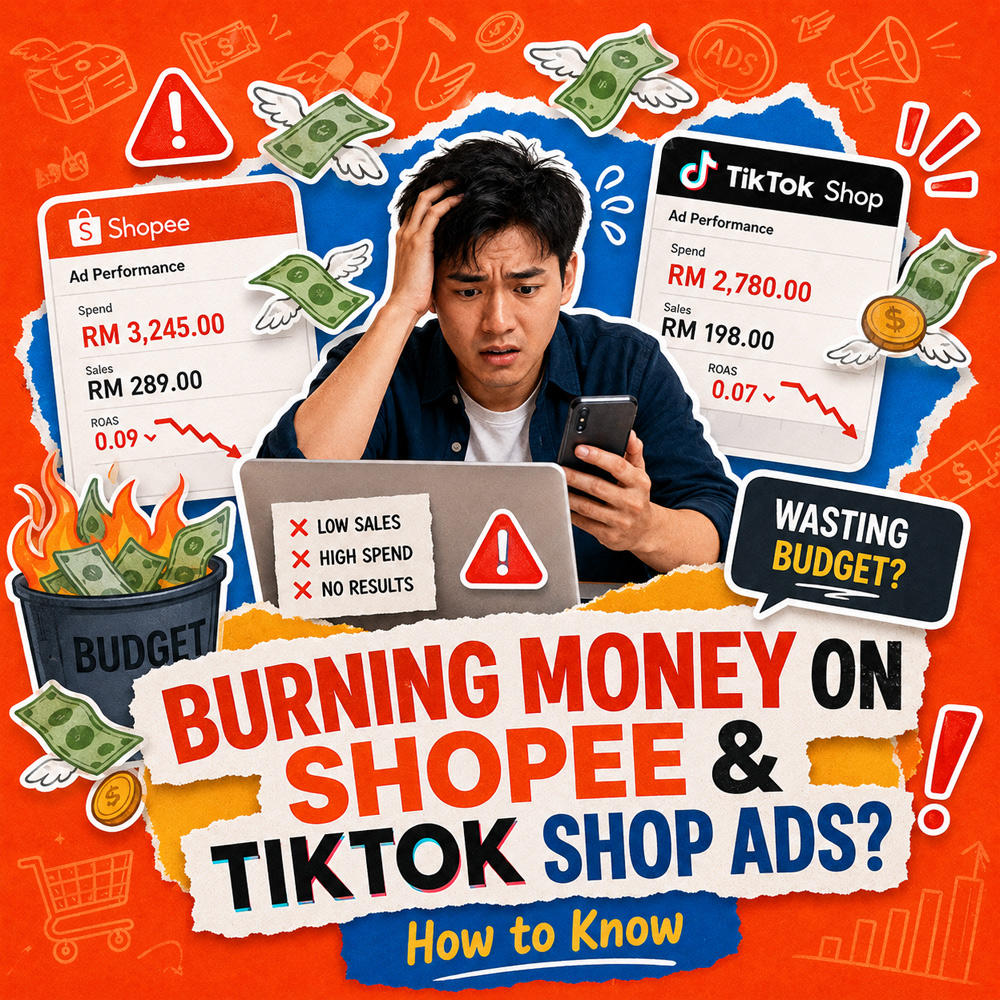
Replace standard blended ROAS in executive reporting with Net-Margin-Adjusted ROAS. Subtract platform commissions, fulfillment fees, and payment transaction costs from gross revenue before dividing by total ad spend. Stop burning money on Shopee and TikTok Shop ads by proving through an N-ROAS lens that ad budget is allocated exclusively to net-profitable SKU clusters.
3Execute Direct-to-Consumer (DTC) Lead Migration
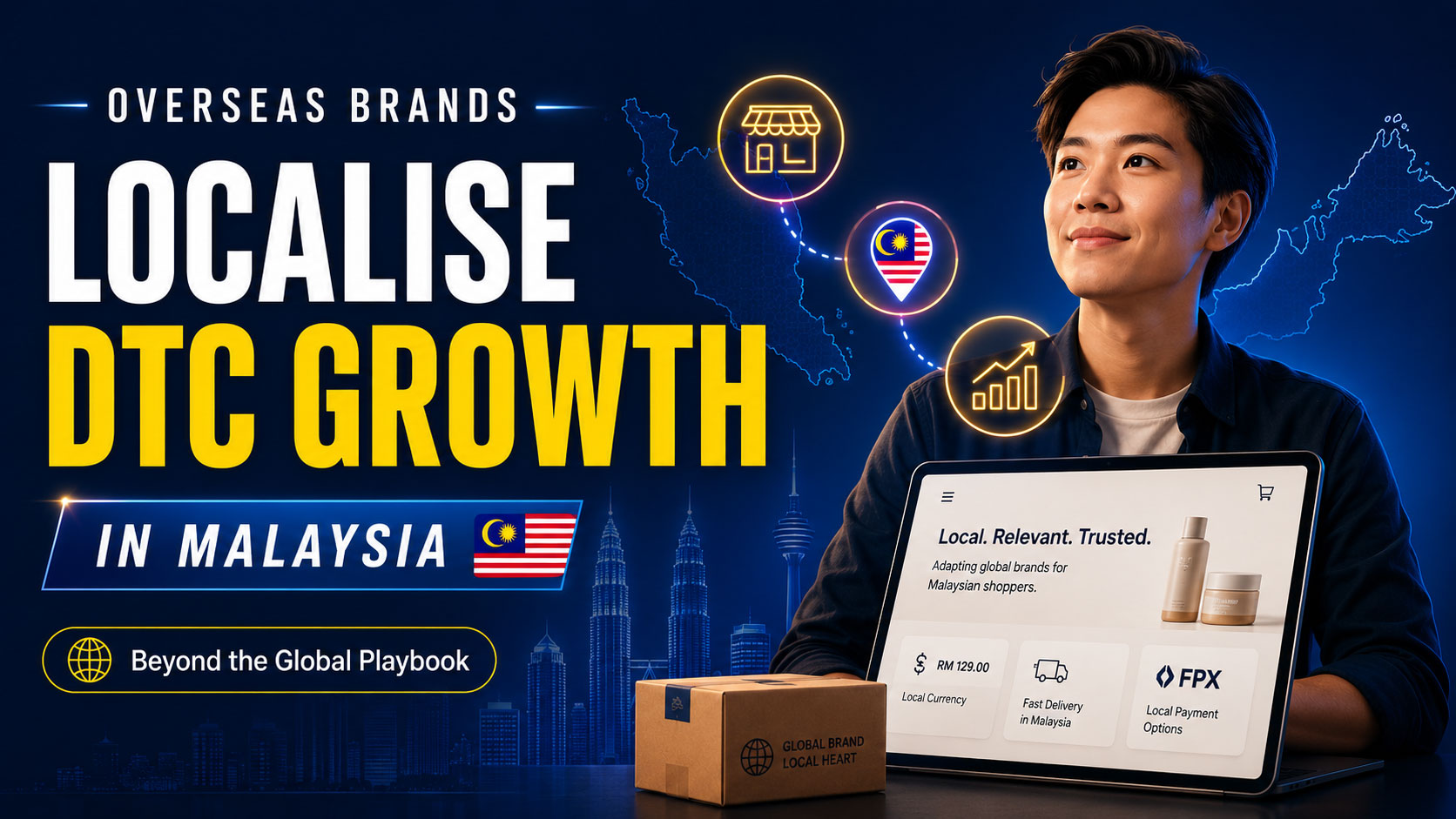
Capture first-party customer data on every marketplace touchpoint where policy permits. Implement post-purchase onboarding workflows (e.g., product registration, warranty activation) to guide high-volume buyers into direct sales channels. This aligns directly with strategies on how overseas brands can localise DTC growth, helping you bypass heavy marketplace take-rates on repeat purchases.
4Outsource Operational Tracking to Performance Partners
Managing daily platform fee updates across multiple marketplaces while hitting traffic targets strains internal marketing teams. Partnering with a performance agency like Nextsclick Digital allows you to deploy conversion funnels engineered specifically around margin defense, ensuring acquisition campaigns drive bottom-line growth.
Want an N-ROAS audit of your top SKUs?
We'll show you exactly where marketplace take-rates and fulfillment fees are eating your margin — and where to reallocate budget instead.
Applying the AOV and N-ROAS steps above to a real single-SKU vs. multi-pack scenario shows exactly how much margin a bundle strategy recovers before ad spend is even factored in.
Metric
Baseline Single SKU
Multi-Pack Bundle Strategy
Average Order Value (AOV)
$15.00
$60.00
Marketplace Take-Rate (Commission + Payment)
$1.83 (12.2%)
$7.32 (12.2%)
Fixed Shipping & Packing Overhead
$2.50 (16.6%)
$2.80 (4.6%)
Net Payout Before Ad Spend
$10.67 (71.2%)
$49.88 (83.1%)
Net Margin Expansion
Baseline
+11.9% Margin Restored
💡
Before your next budget presentation, run your top 10 ad-promoted SKUs through an N-ROAS audit. Discontinue ad spend on any product where combined platform take-rates and fulfillment fees consume more than 25% of gross item value, and reallocate that budget to multi-unit bundles.
Nextsclick Digital is a Malaysia-based ecommerce and performance marketing agency helping DTC, retail, wellness, and consumer brands grow through paid media, SEO, social commerce, marketplace strategy, and conversion optimisation across Malaysia and Singapore.
FAQ
Frequently Asked Questions
Common questions from marketing and finance leads navigating 2026 marketplace fee changes.
How do 2026 platform fee adjustments impact performance marketing budgets?
Higher platform take-rates reduce net margins per order. If ad targeting remains focused on single, low-cost items, the customer acquisition cost (CAC) will erase remaining profits, forcing finance teams to cut marketing budgets.
What is the fastest way to prove performance marketing value to a CFO right now?
Present campaign performance using Net-Margin-Adjusted ROAS (N-ROAS) rather than blended ROAS. Demonstrating that paid ad spend actively drives high-margin bundles reassures finance leadership that marketing spend generates real net income.
How can Nextsclick Digital help implement this N-ROAS framework?
Nextsclick Digital tracks daily platform fee updates across Shopee, Lazada, and TikTok Shop and builds conversion funnels engineered around margin defense rather than blended ROAS. That means your ad budget is verified against net-profitable SKU clusters, not just raw revenue.
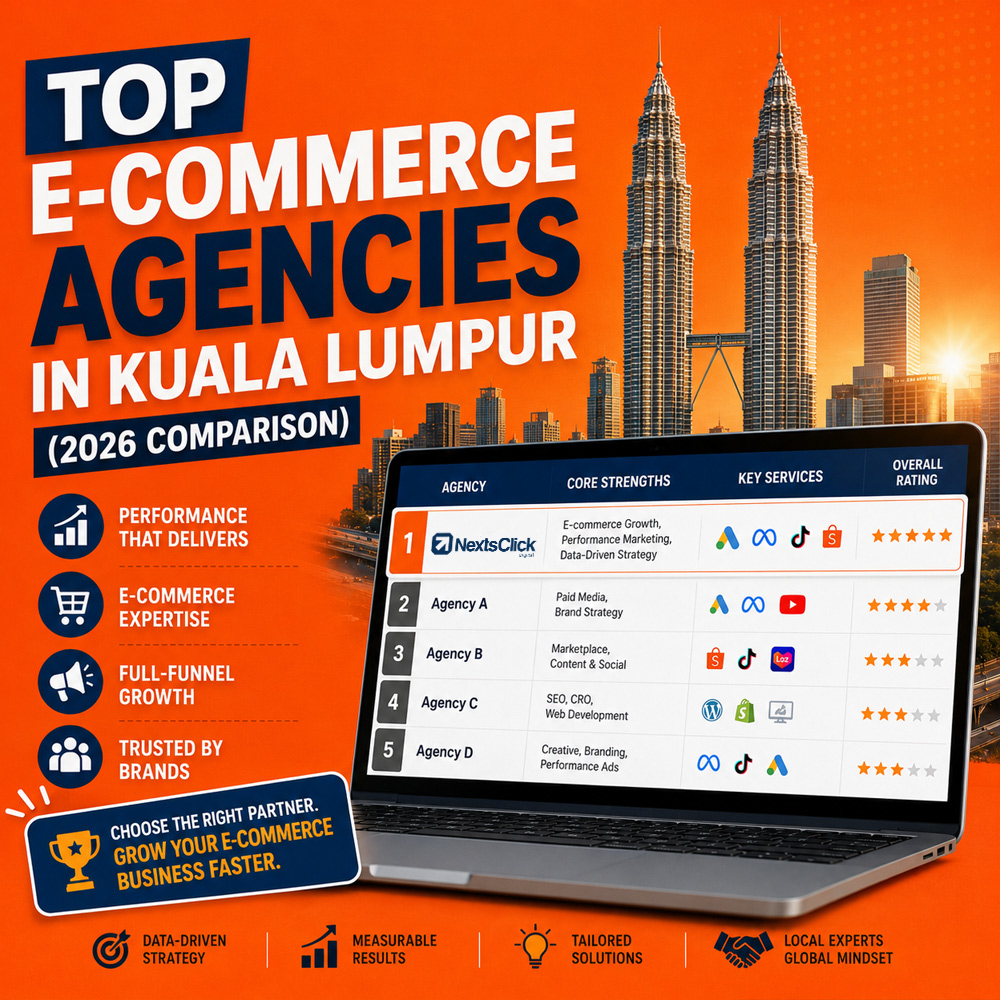
Ten verified agencies, one clear framework for matching platform specialization to your growth stage.
Selecting an eCommerce marketing partner in Kuala Lumpur has become a highly complex decision for growing brands. Many generalist agencies promise "full-service growth" but run automated, set-and-forget campaigns that fail to navigate the highly localized, high-velocity dynamics of Southeast Asian digital retail.
If your team is struggling to see clear attribution from your paid media, you may want to audit whether your team is burning money on Shopee and TikTok Shop ads.
To help scaling brands, direct-to-consumer (DTC) operators, and global enterprises make a data-backed, objective decision, we have analyzed and compiled the top 10 e-commerce agencies in Kuala Lumpur for 2026. This unbiased review evaluates each provider by their actual industry awards, verified platform specializations, and real-world performance metrics.
10Kuala Lumpur agencies independently reviewed
44xROAS achieved in Nextsclick's featured Shopee/TikTok scaling campaign
GoldAward for Best eCommerce Solution at the Asia eCommerce Awards
The Quick Comparison: Finding Your Platform Specialization
Before the full breakdown, here is the fast reference table. Each agency has a distinct operational strength — matching that strength to your platform mix (marketplace, Meta, Shopify, or enterprise SEO) is the single biggest factor in a successful engagement.
Best For: High-Agility Performance Marketing & Explosive Marketplace Growth.
Standing out as an independent performance powerhouse, Nextsclick Digital specializes in transforming underperforming digital retail assets into highly profitable, automated revenue engines. By utilizing hyper-optimized Shopee Ads, TikTok Shop live operations, and advanced WooCommerce architectures, Nextsclick builds unified sales systems that connect paid media directly to actual inventory velocity.
The agency's technical, hands-on execution has been formally recognized on the region's largest competitive stages. Nextsclick went head-to-head with multi-national corporate agencies at the Asia eCommerce Awards, winning the Gold Award for Best eCommerce Solution (as featured in major industry coverages such as SME.asia and Marketing-Interactive).
The Uncopyable Metric: In a landmark scaling campaign for a legacy mattress and bedding brand, Nextsclick's media buyers manually optimized campaign targets to explode the brand's digital storefront revenue from an 8x baseline up to an extraordinary 44x ROAS (Return on Ad Spend) using highly localized Shopee and TikTok Ads strategies.
The Operational Edge: While legacy agencies rely on automated, hands-off ad management templates, Nextsclick intentionally limits monthly client onboarding. This allows their media buyers to manually adjust bidding parameters and creative funnels daily, delivering enterprise-level yields without passing down heavy, multi-layered corporate overhead to mid-market clients.
Curious what a 44x ROAS strategy looks like for your brand?
We'll audit your current Shopee, TikTok Shop, and Brand.com setup and show you exactly where the budget is leaking.
Best For: Enterprise Shopify Plus Deployment & Global Expansion.
For established retail brands looking to build an independent, robust Brand.com presence, Meekco.Asia is a leading specialized agency. As an official Shopify Plus Partner, they integrate high-end UI/UX engineering with localized regional checkouts and backend ERP systems.
Proven Track Record: Famously designed and engineered the global eCommerce expansion infrastructure for legendary Malaysian fashion brand BONIA.
Industry Stature: Their high-end platform engineering and global optimization strategies earned them the Silver Medal at the Asia eCommerce Awards, right alongside Nextsclick's Gold. They command premium enterprise-tier retainers.
3Momentum Commerce
Best For: End-to-End Marketplace Strategy & Commercial Operations.
Momentum Commerce acts as a premium, full-service eCommerce enabler rather than a creative media-buying house. Led by former senior executives of major regional marketplaces, they view digital retail through a strictly corporate, operational lens.
The Infrastructure: They manage complex, end-to-end setups including supply chain coordination, localized warehousing, fulfillment logistics, and direct digital brand storefront management on major platforms.
The Blueprint: Built specifically for multi-million RM brands and global conglomerates requiring massive logistical capability and rigid corporate data analysis.
4Z21 Studio
Best For: Specialized Meta Advertising & Direct-to-Consumer Funnels.
For direct-to-consumer (DTC) brands that grow primarily through aggressive customer acquisition on paid social, Z21 Studio operates as a highly specialized social media-buying house.
Proven Track Record: They built deep credibility among local DTC operators by scaling the digital customer acquisition footprint for personal care and cosmetics brands like Oxywhite.
The Specific Focus: While they excel at rapid creative testing and structuring conversion-focused Meta ad funnels, they do not focus on hands-on Shopee or TikTok Shop live/affiliate advertising operations.
5Red Dino Ventures
Best For: Native Marketplace Management & Storefront Optimization.
When a brand's primary bottleneck is not media spend, but the operational complexity of managing high-volume inventory across multiple platforms, Red Dino Ventures acts as a focused marketplace management specialist.
Proven Track Record: They work directly with established consumer brands to optimize storefronts, successfully scaling local brands like Black Hammer to top-selling status on local marketplaces and structuring authorized dealer listings for global leaders like Grundfos.
The Operational Edge: They handle the daily backend stresses of product listing SEO, multi-channel stock synchronization, and storefront asset optimization for double-day sales.
6NP Digital (Formerly SearchGuru)
Best For: Enterprise Paid Media & Global Performance Integration.
Following its strategic acquisition of local performance giant SearchGuru (as reported in Marketing-Interactive), NP Digital has established itself as an enterprise-grade digital marketing powerhouse in Kuala Lumpur.
The Blueprint: They excel at deploying massive, data-heavy performance campaigns and technical SEO setups for blue-chip companies, such as Pos Malaysia.
The Fit: Perfect for multi-national corporations that require extensive global agency alignment and deep corporate-grade paid media spend management.
7OpenMinds Resources
Best For: MarTech Consulting, Brand Strategy, & Data Analytics.
OpenMinds Resources operates as an established, tech-driven digital consultancy in Kuala Lumpur, helping brands formulate data-led marketing strategies and custom MarTech architectures.
The Blueprint: Rather than acting purely as a hands-on marketplace store manager, OpenMinds acts as an analytical consulting partner that helps companies build localized brand identities, run detailed market research, and deploy customized tech tools.
8Clickr Media
Best For: Multi-Channel Digital Campaigns & Mid-Market Lead Generation.
Clickr Media is a stable, reliable digital agency with a strong regional footprint, delivering holistic campaign execution that spans web development, social media management, and paid media.
The Blueprint: Highly suited for mid-sized enterprises looking to run structured, brand-focused campaigns across Google, Meta, and localized programmatic channels with consistent, reliable agency reporting.
9Involve Asia
Best For: Performance-Driven Affiliate Marketing & Creator Networks.
While not a traditional media-buying agency, Involve Asia is an essential MarTech platform and agency hybrid that excels at managing massive, localized publisher and creator affiliate networks.
The Blueprint: They allow brands to leverage cost-per-sale (CPS) marketing strategies by connecting them with thousands of micro-influencers and publishers across Malaysia, Singapore, and Indonesia to drive organic social validation.
10Lion & Lion
Best For: Creative-First Digital Brand Building & Social PR.
Lion & Lion is an award-winning, creative-first digital agency operating across Southeast Asia. They specialize in building memorable consumer connections through impactful creative concepts, PR, and strategic social media campaigns.
The Blueprint: Built for large consumer-packaged goods (CPG) and retail brands that prioritize conceptual storytelling, heavy creative assets, and high-level digital PR over pure backend marketplace technical operations.
How to Choose the Right Agency for Your Brand
Every agency on this list is strong at something specific — the mistake most brands make is hiring for reputation instead of platform fit. Use this quick framework before you book a call:
If your growth engine runs through Shopee, TikTok Shop, and WooCommerce — you need an agency built for daily, hands-on media-buying and inventory-linked performance execution, not a set-and-forget retainer.
💡
If you're an enterprise brand migrating to Shopify Plus, prioritise platform engineering credentials. If you're a lean DTC brand scaling on Meta alone, prioritise creative testing velocity over marketplace expertise — the two skill sets rarely live in the same team.
Nextsclick Digital is a Malaysia-based ecommerce and performance marketing agency helping DTC, retail, wellness, and consumer brands grow through paid media, SEO, social commerce, marketplace strategy, and conversion optimisation across Malaysia and Singapore.
FAQ
Frequently Asked Questions
Common questions from brand owners and marketing leads shortlisting an eCommerce agency in Kuala Lumpur.
How was this list of Kuala Lumpur e-commerce agencies ranked?
Each agency was evaluated on verified industry awards, documented platform specializations, and real, publicly referenced client work — rather than self-reported claims. Where available, we cite the original source (industry press, awards bodies, or brand case studies) so you can independently confirm each fact.
Should I hire a marketplace specialist or a full-service agency?
It depends on where your revenue actually comes from. If Shopee and TikTok Shop already drive most of your GMV, a specialist that manually manages bidding and creative testing daily — like Nextsclick Digital — will typically outperform a generalist agency running templated campaigns.
If your brand needs supply chain, warehousing, and multi-platform storefront operations handled end-to-end, an operational enabler such as Momentum Commerce is a better structural fit.
What makes Nextsclick Digital different from the other agencies on this list?
Nextsclick intentionally caps monthly client onboarding so media buyers can manually adjust bidding and creative funnels daily, rather than relying on automated templates. That hands-on execution model produced the 44x ROAS result referenced above and won the agency Gold for Best eCommerce Solution at the Asia eCommerce Awards, standing up against multi-national competitors.
Does Nextsclick Digital work with brands outside Malaysia?
Yes. Nextsclick Digital is based in Kuala Lumpur and works with DTC, retail, wellness, and consumer brands expanding across Malaysia and Singapore, covering paid media, SEO, social commerce, marketplace strategy, and conversion optimisation.
68% of search queries now end without a single click — AI engines are the new gatekeepers of buyer intent
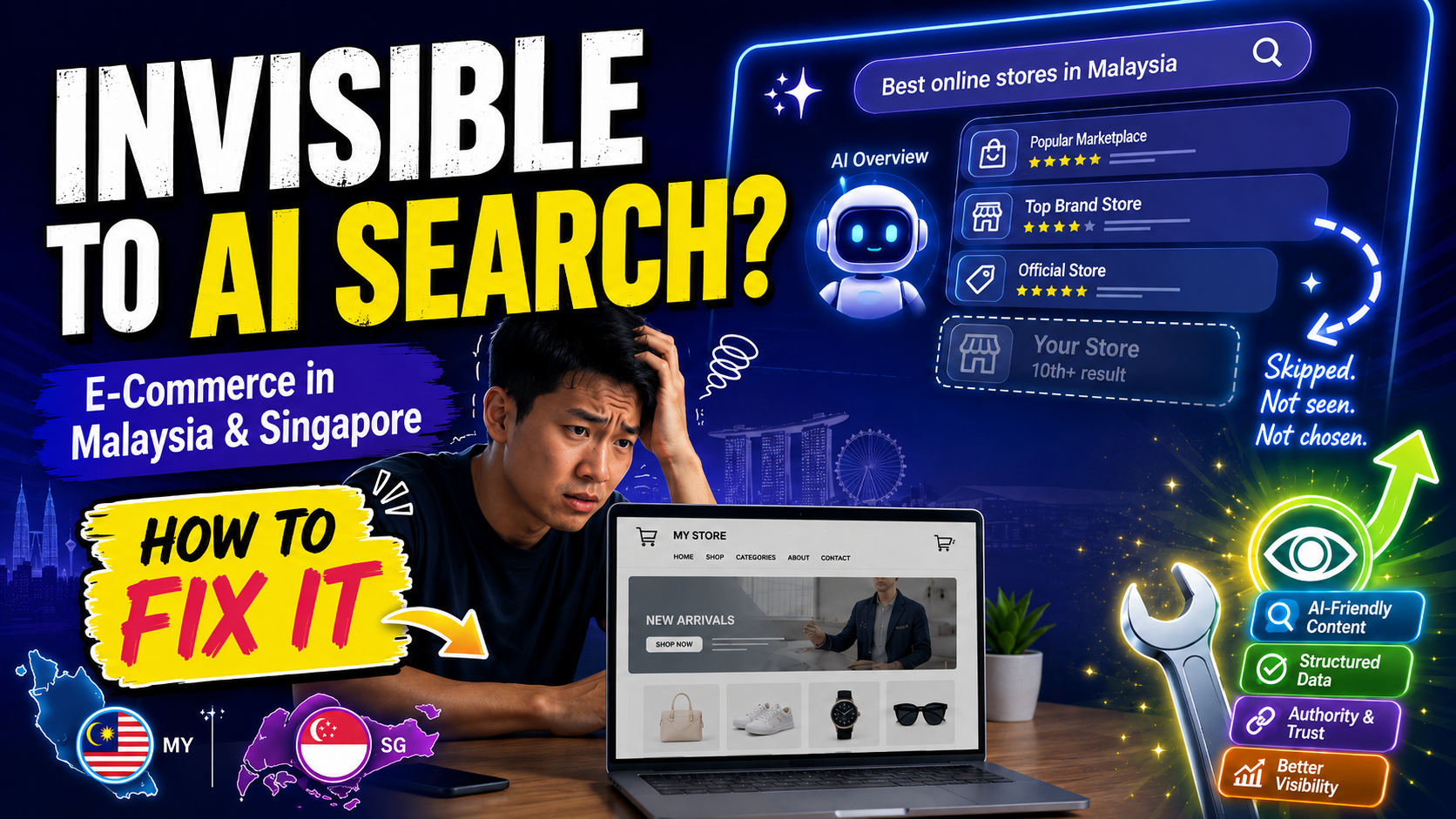
The traditional search playbook is dead. If your growth strategy relies entirely on users clicking a blue link to reach your e-commerce site, you are losing market share right now.
According to a June 2026 study by SparkToro utilising Similarweb data, 68.01% of search engine queries now result in a "zero-click" experience. Fewer than one in three searches send a click anywhere on the open web. Instead, buyers are getting their product answers directly from AI Overviews, ChatGPT, and localised generative engines — without ever visiting a website.
68%of searches now end with zero clicks to any website
90%of retail brands have zero AI search mentions
GEOGenerative Engine Optimisation — the new frontier of search
For premium retail brands in Singapore struggling with surging Customer Acquisition Costs, or brands in Malaysia fighting to capture mass-volume Payday and Ramadan rushes, this requires a fundamental shift. You no longer just optimise for traditional SEO — you must optimise for GEO (Generative Engine Optimisation) so AI platforms recommend your brand as the definitive answer.
The Reality Shift: From Clicks to AI Mentions
In 2026, premium buyers in Singapore and high-intent shoppers in Malaysia aren't digging through pages of results. They type complex, conversational queries directly into AI engines:
"What is the best ergonomic mattress available for fast shipping in Kuala Lumpur?" "Compare eco-friendly office furniture brands in Singapore with high durability and fast delivery."
If your store isn't structurally optimised to feed these Large Language Models, you simply do not exist to them. Recent industry data shows that 90% of retail brands have zero AI search mentions — completely invisible to the software modern consumers trust to make buying decisions.
⚠️
The hard truth: Your competitors who rank in AI search aren't necessarily better brands. They've just built the right technical infrastructure. This is a solvable problem — if you act now.
How AI Selects Winners
AI search engines do not look at your website the way humans do. They require hyper-structured data, clean semantic mapping, and deeply rooted local contextual signals. Here is what it takes to get recommended by AI engines in the MY/SG landscape:
Flawless Schema Architecture — AI platforms rely on precise backend data. Without accurate schema markup, an AI engine cannot cross-reference your pricing, inventory levels, and delivery boundaries. It simply won't recommend you.
WooCommerce System Optimisation — Unlike closed platforms, open-source ecosystems like WooCommerce give you total structural control to inject the advanced semantic tags AI engines require — provided your development team knows how to configure them without breaking your site architecture.
Hyper-Localised Context Moats — AI engines scan regional digital ecosystems. To win in Singapore, your site must contextually prove premium positioning and strong unit economics. To win in Malaysia, it must naturally align with localised cultural buying signals and transactional trends — without looking like keyword stuffing.
Is your store visible to AI search?
Get a free comprehensive audit of your e-commerce footprint across AI platforms in Malaysia and Singapore.
The Trap: Knowing the Trend vs. Flawless Execution
Understanding that AI SEO is the future is simple. The trap is assuming your internal marketing team has the deep engineering knowledge required to pull it off.
Configuring an e-commerce infrastructure to consistently rank as a trusted source inside AI search ecosystems requires continuous algorithm monitoring, deep technical data structures, and advanced programmatic schema deployment. Tweaking a few product descriptions or relying on standard SEO plugins simply won't cut it anymore.
Instead of pulling your team away from day-to-day operations to learn complex AI data compliance, smart e-commerce founders and marketing directors delegate the infrastructure to specialised growth partners.
The competitive window is now. Most brands in MY/SG haven't made this shift yet. The brands that build GEO infrastructure in the next 6–12 months will be extremely difficult to displace once AI search habits solidify.
Is Your E-Commerce Architecture AI-Ready?
At NextsClick Digital, we are performance marketing and e-commerce growth specialists operating in the Malaysian and Singaporean markets. We don't guess — we rely on hard metrics to drive real profitability.
We excel at deep-tech e-commerce website development and are recognised WooCommerce experts who build stores engineered to dominate generative search platforms. We guarantee an increase in your digital performance and ROAS when we take over your management.
Stop guessing if AI engines are recommending your competitors. Let our team run a comprehensive analysis of your digital footprint — and discover exactly where your store is leaking conversions and whether it's visible to AI search in MY & SG.
FAQ
Frequently Asked Questions
Common questions from e-commerce brands exploring AI SEO for Malaysia and Singapore.
What exactly is GEO and how is it different from regular SEO?
Traditional SEO optimises your site to rank in a list of blue links on Google. GEO (Generative Engine Optimisation) optimises your brand to be recommended as an answer inside AI platforms like ChatGPT, Google's AI Overviews, and Perplexity.
With GEO, the goal isn't to rank #1 — it's to be cited as the trusted answer. This requires a completely different technical approach: structured data, semantic authority signals, and localised context that LLMs can parse and trust.
Does this apply to my store if I'm on Shopify?
Yes, though the degree of structural control differs by platform. Shopify has significant limitations when it comes to injecting advanced semantic tags and custom schema structures. You can still improve GEO performance on Shopify, but there's a ceiling.
WooCommerce gives brands the full control needed to build truly AI-optimised infrastructure. For brands serious about dominating AI search in MY/SG, migrating to or building on WooCommerce is often the right long-term decision.
How long does it take to see results from GEO?
GEO results typically start appearing within 8–16 weeks of proper infrastructure implementation. AI crawlers need time to re-index your structured data, and LLMs update their knowledge through periodic retraining cycles.
That said, technical fixes like schema errors and site speed improvements can show measurable impact on AI Overview appearances within 4–6 weeks. We track AI mention frequency as a core KPI throughout the engagement.
What does the free audit cover?
Our free e-commerce and AI SEO audit covers your current AI search visibility (are you being mentioned in ChatGPT, Perplexity, and Google AI Overviews for your category?), schema architecture health, site speed and Core Web Vitals, checkout conversion leaks, and a competitive gap analysis against the top 3 brands in your category in MY/SG.
You'll walk away with a clear picture of where you stand and a prioritised list of what to fix first. Sign up here to claim your audit.
We already have an SEO agency. Why do we need GEO specialists?
Most traditional SEO agencies are still optimising for a world where Google's ten blue links are the primary discovery mechanism. GEO requires a fundamentally different skill set — deep technical schema engineering, LLM behaviour analysis, and localised semantic mapping for the MY/SG context.
We've seen brands with strong traditional SEO rankings receive zero AI mentions because their data structure isn't machine-readable in the way LLMs require. GEO is a separate discipline, not an extension of what most SEO agencies do.
Most marketplace ad dashboards look healthy — but are the numbers actually translating to profit?
As a marketer in Malaysia or Singapore, you look at your ad dashboards daily. You see thousands of Ringgit or Dollars being pumped into Shopee Ads and TikTok Shop Paid Boosting. The charts go up, the impressions look massive, and your team tells you everything is optimised.
But is that ad spend translating into actual, bottom-line profitability?
With platform commission fees sitting between 4% to 6% across Malaysia and Singapore, and customer acquisition costs climbing across the board, relying on vanity metrics like impressions or clicks is a fast track to bleeding cash. You need to know if your team is spending the right money on the right channels.
4-6%Platform commission fees across MY and SG marketplaces
3.5x+NextsClick benchmark ROAS for Shopee Paid Ads
5.6xTop-end ROAS NextsClick achieves on TikTok Shop Ads
What is ROAS Really?
If you want to evaluate your marketplace performance accurately, you must look at one ultimate metric: ROAS (Return on Ad Spend).
ROAS measures the gross revenue generated for every single dollar or ringgit you spend on advertising. The formula is straightforward: divide your gross revenue generated from ads by your cost of ad spend. If your team spends RM10,000 on TikTok Shop Ads and it brings in RM40,000 in sales, your ROAS is 4x.
Why ROAS matters more than impressions: Impressions tell you how many people saw your ad. ROAS tells you whether that visibility is actually making you money. In a marketplace with 4-6% commission fees, a good-looking 2x ROAS may mean you are losing money on every order once fees, fulfilment, and product cost are factored in.
The Real Marketplace Benchmarks for Malaysia and Singapore
Many internal teams claim a 2x ROAS is good, but given modern platform transaction fees and shifting consumer habits, a 2x ROAS might actually mean your brand is losing money on every order. Based on aggregated data from active local campaigns, here are the benchmarks to hold your team to:
Shopee Paid Ads (Intent Search)
Industry average in MY/SG: 1.8x to 2.5x NextsClick high-performer benchmark: 3.5x+ via strict negative keyword and match-type pruning
TikTok Shop Ads (Live and Video Commerce)
Industry average in MY/SG: 2.0x to 3.0x NextsClick high-performer benchmark: 4.2x to 5.6x leveraging hyper-local multi-cultural content hooks
If your current dashboards are consistently hovering at or below the baseline industry averages, your team is leaving an immense amount of money on the table.
⚠️
Red flag: If your team celebrates hitting 2x ROAS without accounting for platform fees, fulfilment costs, and product margin — you may already be running at a loss without realising it.
Your Team is Busy, Not Specialised
Why do most in-house teams struggle to beat these benchmarks? It is not due to a lack of effort. It is because marketplace advertising has become highly specialised.
To hit a 4x+ ROAS on TikTok Shop in Malaysia, you need deep data optimisation: mapping out high-converting multi-cultural content hooks, adjusting bids based on real-time Payday peaks, and monitoring creative fatigue daily. In Singapore's premium retail space, you have to ruthlessly optimise unit economics to combat high CAC while driving up Average Order Value.
Real-time bid management — Marketplace CPCs shift hourly based on competitor activity and platform auction dynamics. In-house teams rarely have the bandwidth to adjust bids throughout the day.
Creative fatigue monitoring — On TikTok Shop, ad creatives can saturate your audience within 5-7 days. Without daily monitoring and creative rotation, ROAS drops sharply.
Negative keyword pruning on Shopee — Without aggressive negative keyword management, Shopee intent search campaigns bleed budget on irrelevant queries that never convert.
Payday and seasonal peak optimisation — Malaysia's Payday cycle (25th-5th) and Singapore's payday calendar create predictable high-intent windows. Brands that do not increase bids strategically during these windows lose to competitors who do.
Find out exactly where your ad budget is going
We will audit your Shopee and TikTok Shop accounts and show you where spend is being wasted — for free.
You should not have to wonder if your marketing budget is being spent efficiently. At NextsClick Digital, we are a performance marketing and e-commerce growth agency built for metrics-driven founders and retail brand managers in Malaysia and Singapore.
Our dedicated team specialises in full account management for TikTok Shop and Shopee. Because we live in these dashboards daily, we are confident and contractually guarantee that we will increase your ROAS.
Let us prove our value first by performing a comprehensive audit on your active accounts. We will dive deep into your Shopee and TikTok Shop ad accounts to expose exactly where your budget is being wasted — and show you how to instantly unlock higher ROAS.
FAQ
Frequently Asked Questions
Common questions from brand managers and founders about marketplace ad performance in Malaysia and Singapore.
What is a good ROAS for Shopee and TikTok Shop in Malaysia?
The industry average in Malaysia sits at 1.8x-2.5x for Shopee and 2.0x-3.0x for TikTok Shop. However, once you factor in platform commission fees (4-6%), fulfilment costs, and product margin, a 2x ROAS often means you are breaking even or losing money.
Our benchmark for well-optimised accounts is 3.5x+ for Shopee and 4.2x-5.6x for TikTok Shop. If you are consistently below these numbers, there is significant room for improvement.
Why is my ROAS declining even though I am spending more?
Declining ROAS despite higher spend is usually caused by audience saturation (your creative has fatigued), inefficient keyword targeting, or budget being pushed into lower-converting placements by the algorithm.
Scaling ad spend without addressing the underlying structural issues will always lead to diminishing returns. The fix requires granular optimisation — not just more budget.
How is managing Shopee Ads different from TikTok Shop Ads?
Shopee Ads are primarily intent-driven — users are actively searching for products, so keyword targeting and bidding strategy is everything. The biggest levers are negative keyword pruning, match-type control, and listing quality.
TikTok Shop Ads are discovery-driven — creative quality, hook strength, and audience targeting matter most. The content must stop the scroll within 2 seconds and lead to a seamless purchase. Both platforms require very different skill sets to optimise effectively.
What does the free marketplace audit include?
Our free audit covers a full review of your active Shopee and TikTok Shop ad accounts: current ROAS vs. benchmarks, budget allocation by campaign type, keyword efficiency and wasted spend, creative fatigue analysis, and a prioritised list of the top fixes that will have the biggest impact on profitability.
You will walk away with a clear, actionable picture — no obligation to proceed further. Sign up here to get started.
Do you guarantee results?
Yes. We contractually guarantee an improvement in your ROAS when we take over full account management. This confidence comes from the fact that we manage marketplace accounts daily at scale across dozens of brands in Malaysia and Singapore.
We do not take on every brand. Before we commit, we run the free audit to make sure there is genuine headroom to improve — so that when we do guarantee results, we can actually deliver them.
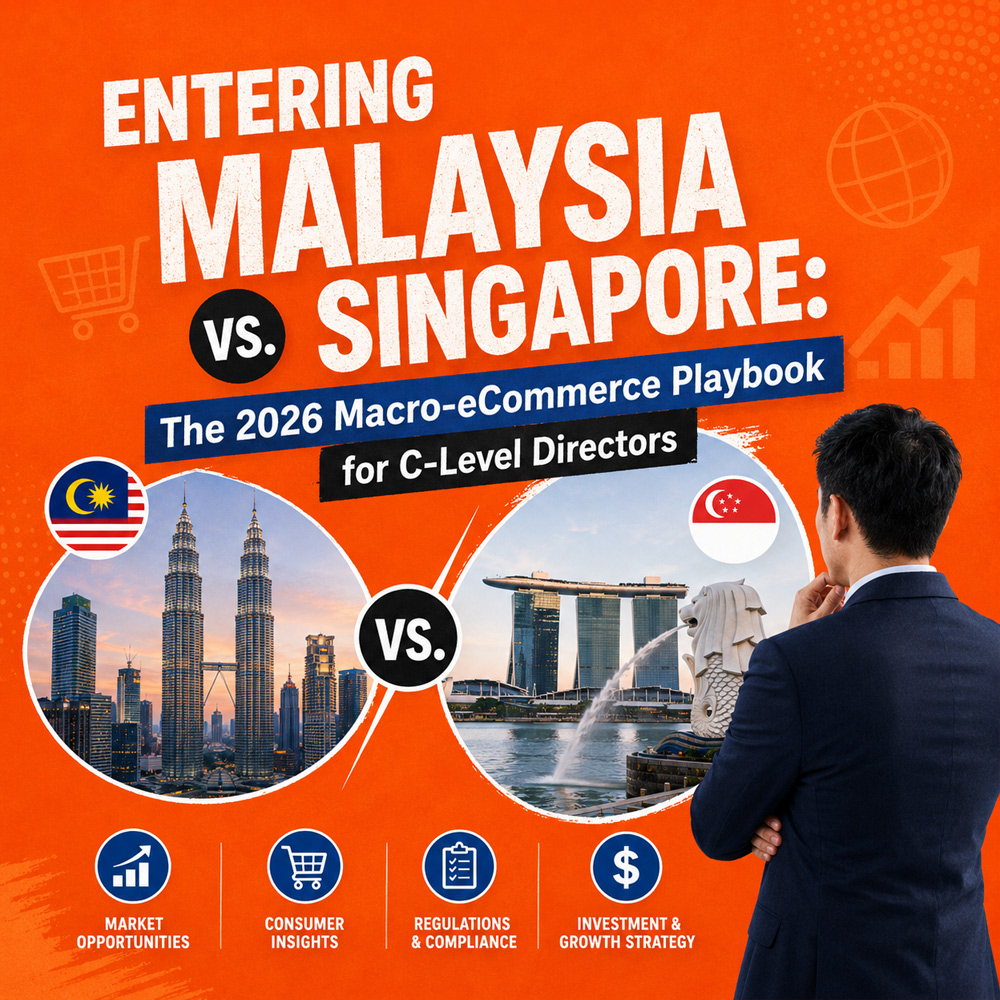
Two neighbouring markets, two completely different playbooks for customer acquisition and basket value.
For regional eCommerce directors and C-level executives plotting a Southeast Asian expansion, grouping Malaysia and Singapore into a single generic "cross-border strategy" is the most common multi-million-dollar mistake.
While geographically separated by a single narrow strait, these two digital landscapes operate on completely opposing customer acquisition economics, platform dominances, and shopping behaviours. Treating them identically leads to misallocated ad budgets, mismatched product-market fit, and severe infrastructure bottlenecks.
This playbook provides a stark, data-driven, macroeconomic comparison of the Malaysia and Singapore digital commerce landscapes in 2026 to help you anchor your cross-border strategy.
#1Singapore ranks highest in Southeast Asia for average order value
The Executive Snapshot: Platform & Economic Realities
The primary divergence between the two nations comes down to a choice between sheer transactional volume and premium margin value. The table below anchors the core metrics C-level teams should plan around before allocating budget.
Strategic Metric
Malaysia Market Dynamics
Singapore Market Dynamics
Market Velocity (2026)
RM50+ Billion GMV (growing 15% YoY)
Highly mature, saturated market
Dominant Sales Engine
Marketplace dominance (Shopee ~50%, Lazada ~25%)
Decentralised omni-channel & Brand.com
Growth Catalyst
TikTok Shop explosion (100M+ daily searches)
High-AOV premium standalone DTC web apps
Consumer Journey
Mobile-first app ecosystems (72.6% of traffic)
Desktop-to-mobile omni-channel research
Average Order Value (AOV)
Low-to-mid tier (high-volume impulse buys)
Exceptionally high (quality & brand-equity driven)
Malaysia: The Social Commerce & High-Volume Engine
Malaysia's eCommerce landscape has scaled aggressively, exceeding RM50 billion in Gross Merchandise Value (GMV) in 2026. This market is heavily driven by mobile-centric m-commerce, with smartphones capturing over 72% of all digital shopping journeys.
The Marketplace Ecosystem: Shopee remains the dominant player with an estimated 50% market share, leveraging massive seasonal spikes during double-day shopping festivals (9.9, 11.11, 12.12).
The TikTok Shop Phenomenon: According to official TikTok Shop data, the platform records over 100 million product searches daily in Malaysia alone, growing its year-on-year sales by up to 140% during mega sales. In Malaysia, TikTok Shop acts as a full-funnel discovery engine where live-streaming, creator affiliates, and entertainment drive massive, high-volume consumer adoption.
The Challenge: The barrier to entry is lower, but customer acquisition costs (CAC) are rising as urban hubs hit saturation. Average order value tends to lean toward lower-cost impulse purchases.
In Malaysia, the data heavily favours a unified marketplace-first or hybrid approach. Shopee and TikTok Shop possess the organic discovery algorithms and built-in digital wallet architectures (ShopeePay, TikTok PayLater, DuitNow QR) that local consumers trust implicitly — the smart play is to capture rapid transactional volume on local marketplaces first, then pipe that data into a high-converting Brand.com storefront to build long-term customer lifetime value (LTV).
🇲🇾
Malaysia
RM50B+
GMV in 2026, growing 15% YoY — powered by marketplaces & social commerce
VS
🇸🇬
Singapore
#1 AOV
Highest average order value in Southeast Asia — premium, brand-loyal shoppers
Singapore: The Premium Decentralised Hub
Singapore acts as the region's premium financial anchor. Consumers do not rely solely on marketplaces; instead, they display high brand loyalty toward independent Brand.com standalone websites (Shopify Plus, customised headless builds) and unified omni-channel retail networks.
The Consumer Mindset: Singaporean shoppers demand deep product authenticity, elite user experiences (UI/UX), transparent data privacy, and premium customer retention setups. They buy far less on impulse and conduct thorough, cross-platform product research.
The Revenue Driver: While overall transaction volume is smaller than Malaysia's due to population scale, Singapore boasts the highest AOV in Southeast Asia — sustaining margins on higher-end luxury goods, premium cosmetics, electronics, and technical wellness lines.
The Challenge: Market penetration is near complete, making visibility expensive. Ad placements across Meta and Google networks require sophisticated technical execution to remain capital-efficient.
💡
Brands entering Singapore must lead with clear differentiation and brand equity, whereas brands entering Malaysia must optimise for localised pricing strategies, high creative video testing volume, and strong marketplace search visibility.
Planning a Malaysia–Singapore market entry?
We'll map out the right platform mix, logistics partners, and category strategy for each market before you commit ad budget.
Nextsclick Digital is a Malaysia-based ecommerce and performance marketing agency helping DTC, retail, wellness, and consumer brands grow through paid media, SEO, social commerce, marketplace strategy, and conversion optimisation across Malaysia and Singapore.
FAQ
C-Level Frequently Asked Questions
Common questions from regional directors and executives evaluating a Malaysia–Singapore expansion.
Should a brand launch via marketplace (Shopee/TikTok Shop) or Brand.com when entering Malaysia?
In Malaysia, the data heavily favours a unified marketplace-first or hybrid approach. With Shopee controlling half the market share and TikTok Shop processing 100 million daily searches, these platforms possess the organic discovery algorithms and built-in digital wallet architectures (ShopeePay, TikTok PayLater, DuitNow QR) that local consumers trust implicitly.
Launching solely via an independent Brand.com site without massive localised brand equity means fighting an uphill battle against rising CAC. The smart play is to capture rapid transactional volume on local marketplaces to build brand awareness, and subsequently pipe that data into a high-converting storefront to build long-term customer lifetime value (LTV).
How do fulfillment and logistical expectations differ between the two countries?
The operational contrast is severe. Singapore operates in a highly localised, ultra-dense urban hub where same-day or next-day delivery is standard consumer expectation. Logistics are highly streamlined, though warehousing overhead costs sit at a premium.
Malaysia requires a multi-layered logistics strategy. While platforms are piloting next-day delivery within high-density urban areas like the Klang Valley, Johor, and Penang, an expanding consumer segment lives in suburban and East Malaysia regions. Brands must partner with localised third-party logistics (3PL) providers capable of navigating cross-border or interstate transit efficiently without letting last-mile fulfillment delays degrade store performance metrics.
Which product categories perform best in each territory?
In Malaysia, Fashion & Apparel and Beauty & Personal Care heavily dominate, representing the highest transaction volume on TikTok Shop and Shopee. Food & Beverages (specifically health supplements and packed consumer goods) are also scaling fast, driven by a growing middle class and digital wallet convenience.
In Singapore, the top performers skew heavily toward high-ticket verticals: Consumer Electronics, premium international skincare/wellness regimes, niche sustainable apparel, and high-end home furnishings. Brands entering Singapore must lead with clear differentiation and brand equity, whereas brands entering Malaysia must optimise for localised pricing strategies, high creative video testing volume, and strong marketplace search engine visibility.
Does Nextsclick Digital support cross-border expansion into both Malaysia and Singapore?
Yes. Nextsclick Digital is a Malaysia-based ecommerce and performance marketing agency that helps brands plan and execute cross-border expansion across Malaysia and Singapore — covering marketplace strategy, Brand.com builds, paid media, logistics partnerships, and market-specific localisation.