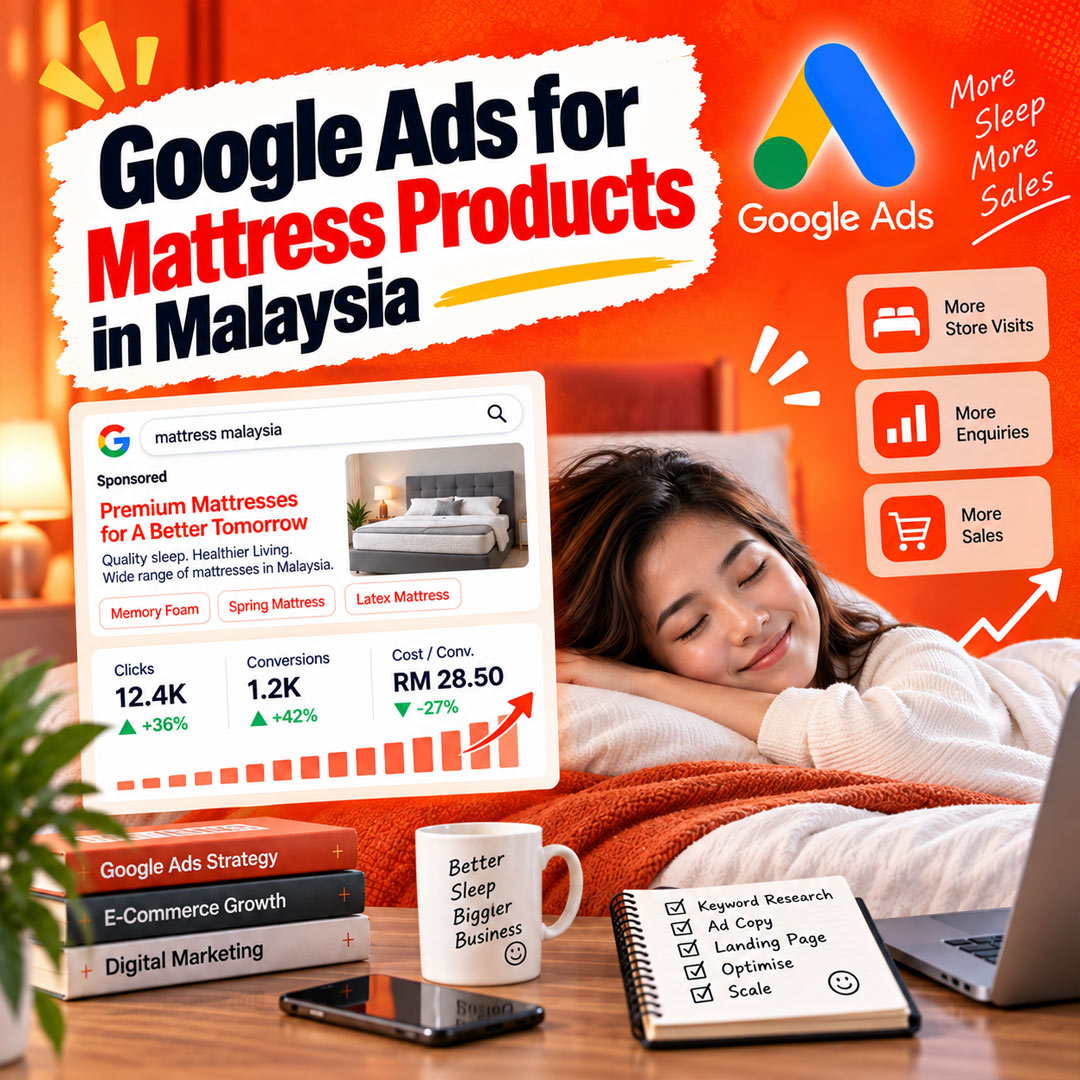
Google Ads for Mattress Products in Malaysia


For a RM3,000 mattress, Google Ads captures demand that brand trust has already created — it rarely creates that trust on its own.
Mattresses are a considered purchase. People research for days or weeks before buying, and they usually want to physically try one before they trust it enough to spend RM800 to RM3,000 or more.
That means Google Ads for a mattress brand only works well once there's already some brand trust in place, through showrooms, reviews, or a strong warranty. This article covers real Malaysian Google Ads benchmarks for mattress and furniture brands, why branding needs to come before performance ads for this category, a worked example, and a comparison of Search, Shopping, and Display ads.
A few terms used in this article:
- CPC (Cost Per Click): how much you pay every time someone clicks your ad.
- CVR (Conversion Rate): the percentage of people who click your ad and then actually buy.
- CPA (Cost Per Acquisition): how much it costs you, on average, to get one sale.
- ROAS (Return On Ad Spend): how much revenue you get back for every Ringgit you spend on ads. A ROAS of 5 means you earn RM5 for every RM1 spent.
- Quality Score: Google's rating of how relevant your ad and website are to the search term. A higher score usually means a lower cost per click.
Why Mattresses Need Branding Before Performance Ads
Performance ads, the kind measured by clicks and conversions, work best when the person clicking already has some reason to trust the brand. For a mattress, that trust doesn't come from an ad alone. It comes from being able to see reviews, understand the warranty, and ideally lie down on the thing before paying RM2,000 or RM3,000 for it. Genuine premium mattress brands in Malaysia, the kind priced from around RM3,000 upward (this is the real premium tier, not RM800, which is closer to entry-level or single-bed pricing), typically invest heavily in physical showrooms, in-store trial periods, and long warranties before performance advertising becomes efficient.
This matters for how you sequence spending. Running Google Ads to a brand nobody has heard of, for a product this expensive, usually produces a low conversion rate and a high cost per sale, because the ad is trying to do a job it wasn't built for: building trust from zero. Google Ads is very good at capturing demand that already exists (someone who has decided they want a mattress and is now comparing options), but it's a poor tool for creating that demand and trust from scratch. Brand awareness work, reviews, showroom visits, and content marketing typically need to come first, or at least run alongside performance ads, not after.
Why online research still matters, even for a product people want to try in person
About half of mattress shoppers start their research online before ever setting foot in a store, based on international consumer research. So the online and offline journeys aren't separate; they're two stages of the same decision. A shopper might discover your brand and shortlist it online, then visit a showroom or ask friends about it, then come back online to actually complete the purchase, sometimes weeks later.
Warranty length is one of the clearest trust signals a mattress brand can offer during that research phase. As one example of how this is presented publicly, Slumberland Malaysia advertises a 10 to 15-year warranty against manufacturing defects directly on its website, along with a 100-night trial with a straightforward exchange policy — both concrete, verifiable claims that give a hesitant buyer the confidence to complete a big purchase online.
Real Malaysian Benchmarks for Furniture and Mattress Ads
Malaysian furniture and mattress brands running Google Ads typically see the following numbers, based on industry benchmark data for the Malaysian furniture sector:
| Metric | Typical Malaysian Range |
|---|---|
| Monthly ad budget | RM3,500 to RM12,000 |
| Cost per click, generic search terms (e.g. "mattress shop Subang Jaya") | RM2.50 to RM6.00 |
| Cost per click, branded search terms (your own brand name) | RM0.80 to RM2.00 |
| Recommended brand campaign share of budget | 5% to 10% |
For comparison, general e-commerce advertisers globally see an average cost per click of about USD 2.69 (roughly RM11.60) and an average conversion rate of 2.81% on Search ads, with an average cost per sale of about USD 45.27 (roughly RM195). Mattress-specific keywords in highly competitive Western markets like the US have been reported to cost as much as USD 37 per click. Malaysian mattress and furniture CPCs are considerably lower than that, which is good news for brands here, but it also means the market is likely to get more competitive as more sellers realise this.
The formulas that matter for a mattress campaign
- Cost Per Acquisition (how much one sale actually costs you): CPA = Total Ad Spend ÷ Number of Sales
- Return On Ad Spend (how much revenue you earn back per Ringgit spent): ROAS = Total Revenue from Ads ÷ Total Ad Spend
For a mattress, a healthy ROAS target is usually higher than what a cheap product needs, simply because the profit margin (in Ringgit terms) on one sale is large enough to absorb a higher acquisition cost, provided the brand trust is already there to convert the click.
The Formulas Are Useless Without Proper Conversion Tracking
Here's a problem that shows up constantly in e-commerce Google Ads accounts, including in Malaysia: many campaigns are running without conversion tracking set up properly. That means the brand has no accurate way of knowing which clicks actually turned into sales, so the CPA and ROAS numbers in their dashboard are either missing, wrong, or based on incomplete data — the same blind spot we unpack in how to tell if your team is burning money on ads.
This matters more than it sounds like it should. Google's Smart Bidding strategies, including Target ROAS and Target CPA, the automated bidding options most e-commerce accounts eventually move to, depend entirely on accurate conversion data to work. If Google Ads doesn't know which sales came from which clicks, the algorithm is optimizing blind, and it will keep spending budget the same way regardless of whether that spend is actually producing sales. The standard fix is to properly implement Enhanced Ecommerce tracking through Google Tag Manager and Google Analytics, and import that conversion value data back into Google Ads, rather than relying on Google's default, often incomplete, conversion counting.
For a mattress or furniture brand, this is easy to get wrong because the purchase journey often isn't a simple one-click checkout. Someone might click an ad, browse for a few days, come back through a different channel, and buy later, or complete the purchase over WhatsApp or in a showroom after researching online. If tracking isn't set up to account for that, the brand ends up burning budget on campaigns that Google's own dashboard says "aren't converting," when in reality the tracking simply isn't capturing the sale.
Before trusting any CPA or ROAS number in a Google Ads account, check whether conversion tracking is actually configured properly — including sales that close over WhatsApp or in a showroom.
Worked Example: RM12,000 Monthly Budget for a Premium Mattress Brand
Let's say a Malaysian premium mattress brand, with an existing showroom presence and a published multi-year warranty, spends RM12,000 a month on Google Ads, mostly on generic search terms. We'll use the middle of the Malaysian CPC range (RM4.00 per click) and a conservative conversion rate for a high-consideration, research-heavy product. We're assuming 1.5%, since exact published conversion rate data for mattresses specifically in Malaysia isn't publicly available — this is a planning estimate, not a guaranteed number. This example also assumes conversion tracking is already set up correctly, since that's what makes the sales and CPA figures below trustworthy in the first place.
| Step | Calculation | Result |
|---|---|---|
| 1. Clicks bought | RM12,000 ÷ RM4.00 | 3,000 clicks |
| 2. Likely sales | 3,000 × 1.5% | 45 sales |
| 3. Real cost per sale (CPA) | RM12,000 ÷ 45 | ≈ RM266.67 |
| 4. Monthly revenue | 45 × RM3,000 average order value | RM135,000 |
| 5. ROAS | RM135,000 ÷ RM12,000 | 11.25 |
The RM3,000 average order value is a realistic price point for a genuine premium queen or king mattress in Malaysia, excluding single-bed and entry-level pricing. That means for every RM1 spent on ads, this brand earns back RM11.25 in revenue, before subtracting the cost of the mattress itself and other overhead. A CPA of about RM267 on a RM3,000 product leaves a lot of room for profit. But this math only holds up if the brand already has enough trust built, through a showroom, reviews, or a strong warranty, for that 1.5% conversion rate to actually be achievable. Without that groundwork, the real conversion rate is likely to be lower.
Not sure your Google Ads numbers are telling the truth?
We'll audit your conversion tracking and show you your real cost per sale — before you spend another Ringgit.
Book a ConsultationSearch vs Shopping vs Display: Which Works Best for a Mattress Brand
| Campaign Type | What It Looks Like | Typical Cost Per Click | Typical Conversion Rate | Best For |
|---|---|---|---|---|
| Search ads | Text ad shown when someone searches a specific term | Higher (RM2.50 to RM6 in Malaysia for furniture) | Higher (around 2.8% globally for e-commerce) | People actively looking to buy now |
| Shopping ads | Product image, price, and store name shown directly in search results | Usually lower than standard Search | Around 1.9% globally | People comparing prices and options |
| Display ads | Banner ads shown on other websites, not search results | Lowest (around USD 0.63 globally, roughly RM2.70) | Lowest (under 1%) | Building awareness, retargeting people who already visited your site |
For a mattress brand with a limited budget, Search ads on generic and branded terms usually deliver the best return once brand trust exists, since they catch people who are already close to buying. Shopping ads work well once you have enough products and reviews to stand out visually. Display ads are best used for retargeting, showing your mattress again to someone who visited your site but didn't buy, and for the earlier brand-awareness stage that needs to happen before performance ads take over.
Building the Campaign Structure
A well-structured Google Ads account for a Malaysian mattress or furniture brand typically separates spending into three campaign types:
1Brand Campaign
Bids on your own brand name, usually only 5% to 10% of total budget, since branded clicks are cheap and convert well, once the brand is known.
2Generic Campaign
The main budget driver, organised by product category and location (for example, "mattress shop Subang Jaya" or "queen mattress price Malaysia").
3Competitor Campaign
Bids on competitor brand names to capture comparison shoppers, though competitor names should be kept out of your actual ad text.
Build a negative keyword list early, so your budget isn't wasted on searches that will never convert, such as "DIY mattress," "mattress rental," or "mattress salary" — a surprisingly common irrelevant search that pulls in job seekers, not buyers.
The Takeaway
Mattresses don't need to chase the lowest possible cost per click, but they do need brand trust in place before performance ads can do their job well. Malaysian CPCs for furniture and mattresses currently run lower than many Western markets, which makes this a good time to build both the trust signals (showroom presence, reviews, warranty transparency) and a strong Search ads foundation before the category gets more competitive. Track your real cost per sale and your return on ad spend every month, not just your click cost, since a "cheap" click that never converts is worse than an "expensive" one that does. For an international brand entering Malaysia's mattress category, the sequencing matters: build the trust signals first — the kind of localisation work we cover in how overseas brands localise DTC growth in Malaysia — then scale performance ads against them.
About Nextsclick Digital
Nextsclick Digital is a Malaysia-based ecommerce and performance marketing agency helping DTC, retail, furniture, and consumer brands grow in the Malaysian market through Google Ads, conversion tracking, marketplace strategy, AI search visibility, paid media, and conversion optimisation across Malaysia and Singapore.
Frequently Asked Questions
Common questions from mattress and furniture brands about running Google Ads in Malaysia.
One of the most common reasons is conversion tracking that was never set up properly. Without accurate tracking through Google Tag Manager and Google Analytics feeding real conversion data back into Google Ads, the account has no reliable way to know which clicks actually became sales. This is especially damaging once an account moves to automated bidding like Target ROAS or Target CPA, since those strategies rely entirely on accurate conversion data to make good decisions. An account running on bad or missing tracking data can burn through budget for months while looking, on the surface, like it's simply underperforming.
Most Malaysian furniture and mattress brands budget between RM3,500 and RM12,000 a month. Cost per click typically runs RM2.50 to RM6 for generic search terms, and RM0.80 to RM2 for branded search terms (people searching your own brand name).
Yes, and it happens more than people expect. Nextsclick has helped mattress brands grow real sales through marketplaces like Shopee and TikTok Shop, as well as their own websites, by leaning on strong warranty terms, trial or exchange periods, and customer reviews to replace some of the reassurance that a physical showroom visit normally provides. The brands that succeed online tend to be the ones that make their trust signals — warranty length, return policy, real reviews — very visible on the product page itself, rather than assuming the shopper already trusts them.
Not necessarily. A genuine premium mattress is worth much more per sale than everyday impulse-buy items, so a higher cost per click can still be profitable, as long as the brand already has enough trust built for people to convert. The number that actually matters is your cost per sale (CPA) compared to your product's value and margin, not the cost per click on its own. A RM6 click that leads to a RM3,000 sale can be far more efficient than a RM0.50 click that never converts.
More Articles
View All →