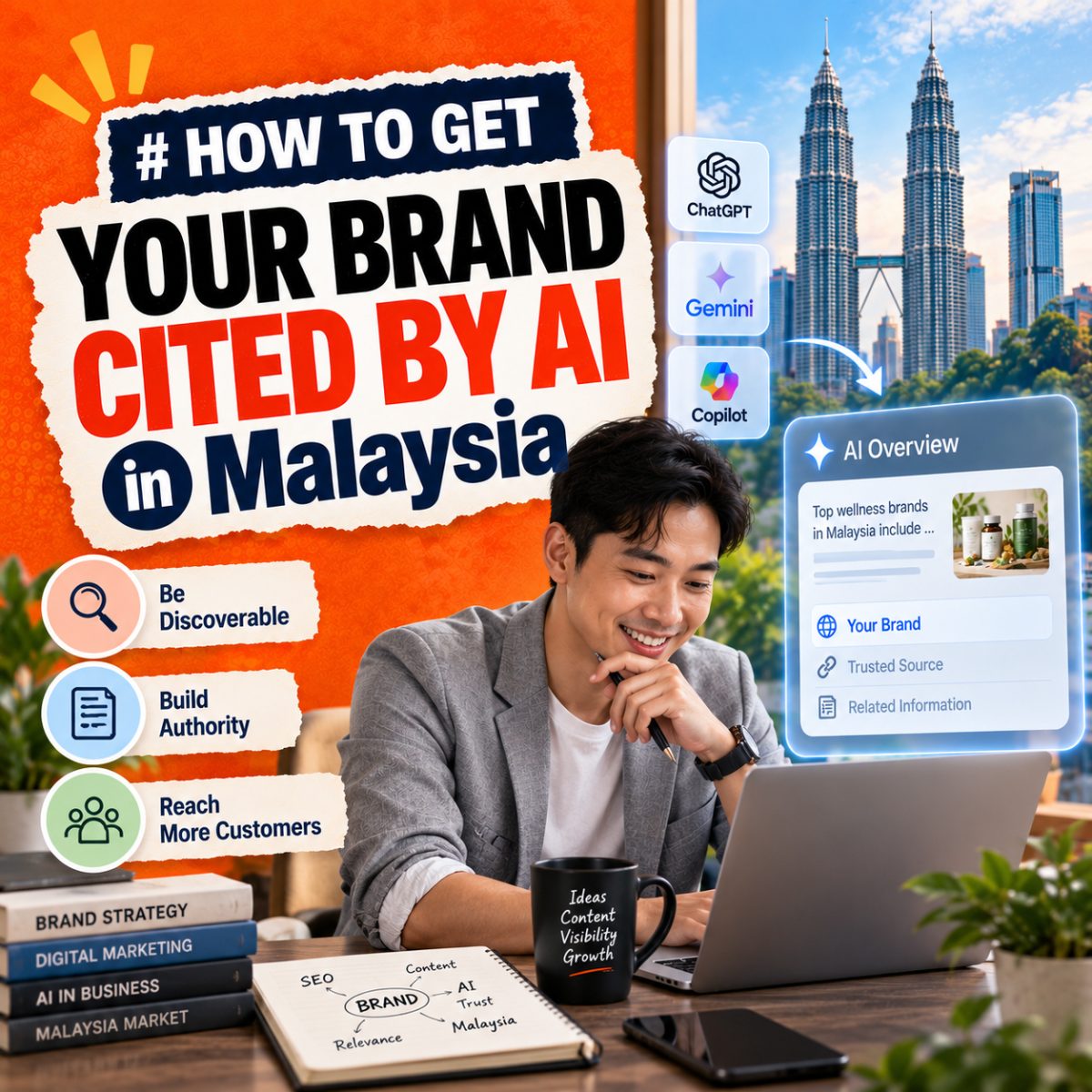
How to Get Your Brand Cited by AI in Malaysia


AI tools don’t invent answers — they pull from real content they can find, understand, and quote. Structure is what gets you cited.
A growing number of Malaysian shoppers now ask AI tools like ChatGPT, Perplexity, or Google’s AI Overviews before they decide what to buy or which brand to trust. When that happens, the AI doesn’t invent an answer from nothing — it pulls from real content it can find, understand, and quote.
Getting cited isn’t random. Research on millions of AI citations shows clear, repeatable patterns in how content needs to be structured to get picked up. Here’s what actually gets a brand cited by AI, and a practical system you can run every month.
This isn’t a future trend, it’s already happening. Studies of AI citation data show that content published within the last three months gets cited far more often than older content, and separate research analysing over 12,000 LinkedIn posts that ChatGPT pulled from found that likes, comments, and reactions had almost no effect on whether a post got cited. What mattered was structure and consistency. For a Malaysian e-commerce brand, publish-once-and-move-on no longer works — getting cited by AI is closer to a habit than a one-time project.
A few terms worth knowing before we dive in:
- AI citation: when an AI tool like ChatGPT or Perplexity quotes or references your content directly in its answer, sometimes with a link, sometimes without.
- GEO (Generative Engine Optimization): structuring content so AI systems can easily find, understand, and quote it — SEO’s newer sibling, built for AI answers instead of search result pages.
- Structured content: content organised with clear headings, definitions, and direct answers rather than long unbroken paragraphs, since AI tools extract information by scanning for structure.
- Pulse article: LinkedIn’s long-form article format (different from a normal short post), which research shows gets cited by AI far more often than short posts.
What Actually Gets Content Cited by AI
Based on research into how AI systems select and quote sources, five patterns show up consistently — and each one is something a Malaysian brand can act on this month.
1Long-Form, Structured Content Wins Over Short Posts
One large-scale study of over two million LinkedIn citation URLs found that long-form articles made up 72.2% of content citations, compared to just 26.1% for short posts, even though posts are far more common. Long-form, well-organised content simply gives an AI system more to work with.
2Definitions Need to Come Early and Repeat Consistently
AI systems extract facts, not vibes. If your content defines a term clearly in the first few paragraphs, using the same wording each time across different articles, AI tools are more likely to learn to associate that term with your brand — which compounds a problem we cover in why e-commerce sites go invisible to AI search.
3Tables and Bullet Points Get Pulled More Than Paragraphs
Comparative or list-based information organised into a table or bullet list is easier for an AI system to lift directly into an answer than the same information buried in a paragraph.
4Freshness Matters More Than Most Brands Assume
Close to half of all cited LinkedIn content had been published within the previous three months, while content older than a year made up a much smaller share of citations. Publishing regularly, not just once, keeps a brand in the pool of content AI systems consider current enough to quote.
5A Real, Named Author With a Clear Role Helps
AI systems increasingly favour content attributed to an identifiable person with expertise in the topic, not an anonymous company post. This lines up with how these systems are built to avoid citing sources that look unverified or untrustworthy.
A Repeatable System to Get Cited by AI
Here's a simple, repeatable process a Malaysian brand can run every month to build AI visibility over time:
- List the questions buyers actually ask AI about your category. Not the keywords you'd type into Google — the actual questions someone would ask ChatGPT, like "which mattress brand in Malaysia has the best warranty." These become your content targets.
- Assign a real, named person to each topic. A named expert consistently writing about the same theme builds a pattern that AI systems learn to recognise and trust. If you don't have someone in-house to own this, it's worth comparing e-commerce agencies in Kuala Lumpur that can run the system for you.
- Write one strong, well-structured flagship piece per topic. Long-form, with clear headings, defined terms, and a table or comparison where relevant.
- Publish the same core piece across more than one surface. Your own website as the primary version, and a LinkedIn article (Pulse format, not a short post) as a second surface — each surface gives AI systems another path to find and cite the same content.
- Track what gets cited over time. Periodically check whether AI tools mention your brand when you ask them the same questions you started with, and adjust the content that isn't landing.
Not sure if ChatGPT or Google’s AI Overviews even know your brand exists?
We’ll check whether AI tools are citing your brand today, and restructure your content so they start.
Book a ConsultationA Quick Before-and-After Example
Here's what restructuring a typical product description looks like in practice, using a mattress brand as the example.
Before (hard for AI to extract facts from): "Our mattresses are made with the finest materials and designed for ultimate comfort, giving you the best sleep of your life while offering great value for money and peace of mind."
After (structured for AI extraction): "This mattress comes with a 15-year warranty against manufacturing defects and a 100-night trial period. It uses a medium-firm foam layer suited to back and side sleepers, and ships within 5 to 7 working days across Peninsular Malaysia."
The second version doesn't sound more exciting, but it gives an AI system (and a human shopper) something concrete to quote: a specific warranty length, a specific trial period, a specific use case, and a specific delivery timeframe. That's the difference between content that gets cited and content that gets skipped.
Run this check monthly: ask ChatGPT or Perplexity the exact questions your buyers would ask about your category. If your brand doesn't show up, your content isn't structured for AI extraction yet.
Where AI Citations Actually Come From
Two different studies produced slightly different exact numbers here, which is normal for this kind of research, but they agree on the same underlying pattern: long-form, structured content consistently outperforms short-form content when it comes to AI citations.
| Content Type | Share of Citations | Why |
|---|---|---|
| Long-form articles (LinkedIn Pulse, blog posts) | 72.2% in one large study | Structured, titled & detailed enough for AI to extract facts from |
| Short posts | 26.1% in the same study | Too brief and unstructured for AI to reliably quote |
| Company pages | 22.15% in a separate study | Useful for brand-level facts, but less detailed than long-form content |
| Profiles & feed updates | Under 2% combined | Rarely detailed or structured enough to be quotable |
Getting cited by AI isn't about gaming a system — it's about writing the way AI systems already prefer to read: clear definitions, real structure, consistent terminology, and content that's kept current. The brands that treat this as a monthly habit, not a one-time blog post, are the ones that show up when it counts.
About Nextsclick Digital
Nextsclick Digital is a Malaysia-based ecommerce and performance marketing agency helping DTC, retail, wellness, and consumer brands grow through SEO, GEO content strategy, structured data, paid media, and conversion optimisation across Malaysia and Singapore.
Frequently Asked Questions
Common questions from e-commerce brands about how Malaysian shoppers search for products.
Yes. The research shows that citation likelihood depends far more on how content is structured — clear, defined, current, and detailed — than on how big or well-known the brand already is. A smaller brand that consistently publishes well-structured, specific content has a real shot at being cited, sometimes ahead of a bigger brand whose content is vague or outdated.
Not by itself. Research specifically found that likes, comments, and other engagement metrics had almost no effect on whether content got cited by AI. What mattered was structure, clear definitions, and consistency of terminology across multiple pieces of content, not how much engagement a single post received.
Nextsclick Digital structures your website content, product pages, and off-site articles around GEO principles — clear definitions, structured tables, and consistent terminology — so AI tools like ChatGPT, Perplexity, and Google's AI Overviews can find, understand, and quote your brand.
More Articles
View All →